

31st Jan 2026
Every studio has a process. This article makes ours visible, traced through a single familiar object, from first intent to finished piece.
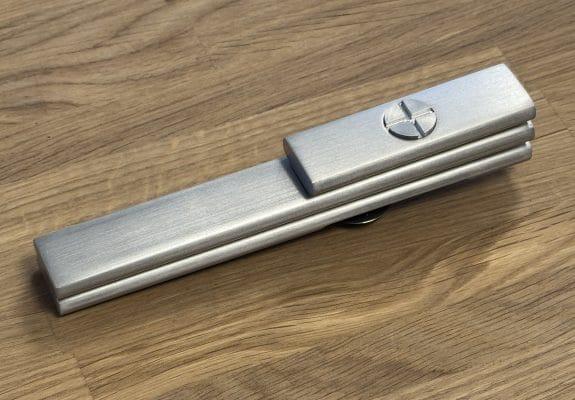
We chose a tin opener. Not because it is complex, but because it is the opposite: an object so thoroughly understood by everyone who uses it that the design conversation could skip straight past what it is and focus entirely on how and why it might be made differently.
This article uses that project to make our process visible. Not in the abstract, but in practice, traced through a real development sequence from initial intent through to production. The object is incidental. The thinking is the point.
Design
We began by studying the lineage of the tin opener itself: its mechanics, material logic, points of failure and moments of friction in everyday use. Countless versions exist, each solving the same problem with marginal variation. Our task was not to reinvent the category but to understand it completely, then decide where intervention was meaningful.
Sketching, physical references and ergonomic studies informed early directions, while constant questioning narrowed the field. What is essential? What is redundant? What can be quieter, clearer, more deliberate? Design, in this context, became an act of reduction. The outcome was not a dramatic departure but a considered evolution, one that set a clear foundation for what followed.
Not every project demands exhaustive exploration. But clarity often benefits from depth, and we deliberately chose a thorough approach here. The familiarity of the object meant the design conversation was unencumbered by explanation. That is rare, and we used it.
Prototype
For the tin opener, prototyping was used as a thinking tool rather than a validation step. Each prototype was not simply a step closer to manufacture but a means of learning, about material behaviour, user interaction and mechanical nuance. The phase expanded and contracted as required, responding to discoveries rather than adhering to a fixed sequence.
Low-fidelity prototypes explored grip, leverage and hand positioning. These were followed by functional assemblies that tested cutting performance and force distribution. Subtle adjustments, millimetres in handle thickness, degrees in angle, changes in surface finish, produced disproportionate effects. The familiarity of the object made these differences immediately perceptible.
Not every project warrants this level of iteration. Some benefit from speed, others from precision. Here, the intention was clarity through repetition. By the time the design was resolved, it had been held, tested and quietly challenged many times over.
Manufacturing
At Studio Sowow, manufacturing considerations are embedded earlier than most studios work. For the tin opener, production constraints informed decisions from the outset, ensuring that refinement did not rely on impractical complexity. Materials were selected for both performance and longevity. Processes were chosen for repeatability and precision, not novelty.
This phase refined rather than redefined the product. Tolerances were tightened, surfaces resolved and assembly simplified. Each decision reinforced the original intent: an object that feels inevitable rather than overstated. The transition from prototype to production was not a compromise but a continuation of the same thinking applied with different tools.
Why this matters for your project
Through the lens of a single familiar object, this project demonstrates one expression of our process at its most considered. Not every brief requires this depth, but every project benefits from the same principles: clarity of intent, responsiveness to discovery, and respect for making.
Design, prototyping and manufacturing are not isolated stages. They are interconnected acts, each informing the next, each essential to the whole. Understanding how they connect is what allows us to compress them when speed is needed, and expand them when quality demands it.
→ Download this article as PDF
Start a Project
Tell us what you need to build. We will take it from there.